Saturday, 5 August 2017

10 tips to help you get your first 1,000 subscribers


Getting more subscribers can seem like a difficult task, but I’ll share 10 tips to help you get your first 1,000 subscribers.
1. Post Useful Content Consistently
This is one of the most difficult things to do as a content creator.  If you take a look around YouTube you might think that every video under the sun has been created and that is most likely true, but you can put your own spin on a popular topic.  For example, there are many “unboxing” tech videos…what if you created a “reboxing” and talk about the various components of tech while you put it back in the box?  The key here is creativity and that will certainly boost subscriptions.
2. Name Your Videos Strategically
One of the most difficult things is to name your video. You have the name in your head, but it may be something complex or too long.  My rule is to keep it basic and use the YouTube autocomplete to name the video.  There is nothing wrong with your video having the same name or something close to a popular video, as long as it’s relevant.
3. Spruce Up Your Channel Design
Most visitors first impression of you is from your channel and your design. This is where visitors interact and get to know what you are about.  Create a engaging header and show off your brand.  On my channel, we were intentional about our design making it fit into our overall branding strategy. The key takeaway is to design with purpose.
4. Show Your Lighter Side
Lighten up and laugh at yourself.  Bloopers make you more human and show something different than an ordinary talking head video. Also, switch up the video and catch your viewers off guard so they don’t know what to expect.
5. Shoot In Various Locations
I believe that shooting in various locations can lead to more interest. I understand that may not be possible or you may have a set, but try to change a background or even use a green screen. Like the cliché says, “variety is the spice of life” so mix it up with your backgrounds and locations.
6. Create A Custom Thumbnail
I have seen my subscriptions and views increase by adding this step.  I use impact font that is seen on many internet photos to grab attention and I format the photo using Adobe Photoshop.
I usually title the photo thumbnail differently than the video because when people are scrolling through other videos to view, they can easily tell what my video is about.
7. Use Annotations
Annotations are those annoying things that pop up during videos, but they can be a content creator’s dream.  I add annotations to every video and make it easy by creating a link for them to subscribe.  This is extra work, but once you see your subscription rate increase you will continue to add them to every video.
8. Ask For Subscribers
This is very basic. At the end of every video ask viewers to “like” and subscribe to your channel.  You should also tell them why they should subscribe, for example if you are a  ABC  channel I would say, “subscribe for my ABC projects, tricks and insider tips delivered to you weekly.” Remember, be careful what you ask for, because you might get it.
9. Be Yourself 
You are the best you—you can be. Being on camera was difficult for me at first because I compared myself to others who are natural on camera talent then I realized, “I just have to be me.”   Let your personality shine in your videos and I guarantee someone will connect with you.
10. Create An Engaging Channel Trailer 
With the new channel design, YouTube gives content creators a great opportunity to create a trailer to share what your content is about. Have you ever attended a movie without viewing a trailer? Not me, because you want to see what it is about.  Keep your trailer under 90 seconds and show scenes from your other videos and provide a strong call to action of why a viewer should become a subscriber.
Keep people coming back by putting some effort into your videos. Did you notice I didn’t mention any technical details about lighting, audio and composition?  This is because I assume you should know that already.  The more comfortable you are on camera the more subscribers you can get. It may take a while, but you can do it.
What other methods do you use to get subscribers on YouTube? Leave in the comments below.

Marekting Funnel

What is the marketing funnel?

The marketing funnel is a visualization for understanding the process of turning leads into customers, as understood from a marketing (and sales) perspective. The idea is that, like a funnel, marketers cast a broad net to capture as many leads as possible, and then slowly nurture prospective customers through the purchasing decision, narrowing down these candidates in each stage of the funnel.
Ideally, this marketing funnel would actually be a marketing cylinder, and all of your leads would turn into customers. Though this is not a reality for businesses, it is part of a marketer’s job to turn as many leads into customers as possible, thus making the funnel more cylindrical.
It’s important to note that there is not a single agreed upon version of the funnel; some have many “stages” while others have few, with different names and actions taken by the business and consumer for each. In the diagram below, we’ve done our best to pull out the most common and relevant funnel stages, terms, and actions so this information is useful to as many marketers as possible.

Marketing funnel stages and conversions

I’ll take you through the funnel stage by stage so you have a full understanding of how it works.
marketing funnel
Awareness: Awareness is the uppermost stage of the marketing funnel. Potential customers are drawn into this stage through marketing campaigns and consumer research and discovery. Trust and thought leadership is established with events, advertising, trade shows, content (blog posts, infographics, etc.), webinars, direct mail, viral campaigns, social media, search, media mentions, and more. Here, lead generation takes place, as information is collected and leads are pulled into a lead management system for nurturing further down the funnel.
Interest: Once leads are generated, they move on to the interest stage, where they learn more about the company, its products, and any helpful information and research it provides. Here is an opportunity for brands to develop a relationship with the people in its lead database and introduce its positioning. Marketers can nurture leads through emails, content that is more targeted around industries and brands, classes, newsletters, and more.
Consideration: In the consideration stage, leads have been changed into marketing qualified leads and are seen as prospective customers. Marketers can send prospects more information about products and offers through automated email campaigns, while continuing to nurture them with targeted content, case studies, free trials, and more.
Intent: To get to the intent stage, prospects must demonstrate that they are interested in buying a brand’s product. This can happen in a survey, after a product demo, or when a product is placed in the shopping cart on an ecommerce website. This is an opportunity for marketers to make a strong case for why their product is the best choice for a buyer.
Evaluation: In the evaluation stage, buyers are making a final decision about whether or not to buy a brand’s product or services. Typically, marketing and sales work together closely to nurture the decision-making process and convince the buyer that their brand’s product is the best choice.
Purchase: You’re here! This is the last stage in the marketing funnel, where a prospect has made the decision to buy and turns into a customer. This is where sales takes care of the purchase transaction. A positive experience on the part of the buyer can lead to referrals that fuel the top of the marketing funnel, and the process begins again.

How does the marketing funnel differ for B2C and B2B brands?

To help you better understand how the marketing funnel differs for B2C and B2B brands, take a look at the modified diagram below, which outlines B2C and B2B consumer actions and conversions in each stage of the funnel.
marketing funnel
Key differences between B2C and B2B marketing funnels:
  • Most B2C consumers navigate the funnel alone or with a small group of trusted advisors (usually friends and family), while B2B consumers typically have a larger, cross-departmental buying group. The average B2B buying group is 5.4 people.
  • B2C consumers may never directly interact with a company representative, especially on ecommerce websites, while B2B consumers typically interact with a sales representative in the lower end of the funnel.

how to write Articles ?

Write a How-to Article in 6 Easy Steps

STEP 1: SELECT YOUR TOPIC.
Choose a topic that interests you enough to focus on it for at least a week or two. If your topic is broad, narrow it. Instead of writing about how to decorate your home, try covering how to decorate your home in country style on a shoestring budget. That’s more specific and, as such, easier to tackle.
Then write a rough, rough draft, including everything you can think of. Stay loose, avoid getting analytical, and enjoy the process of sharing what you know. When you’re done, you’ll have the bare bones of an article that only you could write. Then put it aside for a while.
STEP 2: ADDRESS YOUR AUDIENCE’S NEEDS.

Now, come back to your piece. Switch gears and imagine you’re the reader of this article. Pick three words to describe the audience you want to address (e.g., professionals, single men). As this reader, what questions would you like answered? You might not know the answers yet, but list the questions anyway; you’ll find answers in the next step.
STEP 3: RESEARCH.

Research will ground your article in fact. Good details to include with your how-to are:
  • Statistics
  • Quotes by well-known people
  • Definitions
  • Anecdotes (short, illustrative stories about yourself or someone else)
  • Quotes and examples from people like the reader or from popular books on the subject
  • References to other media (film, television, radio)
  • Helpful tools, resources or products (if many, consider creating a sidebar)
  • References to local venues or events (if for a regional/local publication).
Collect everything you have gathered and put it in a folder, an electronic document, a notebook or whatever you like. Don’t forget to keep track of sources in case you are later asked by an editor to verify them. You may want to sift through your research at a separate sitting from gathering it. Or just go ahead and sprinkle your research in right when you find it. It’s a lot like cooking—play around until you feel you have it “just right.”
STEP 4: TIGHTEN YOUR DRAFT.

Keeping your audience in mind, write a tighter draft incorporating the new supporting information you’ve collected. Sometimes what you’ve learned in Steps 2 and 3 may compel you to start over with a completely fresh draft. Or you may just want to revise what you have as you proceed, retaining a nice conversational tone by directly addressing your audience.
This time when you read your draft, ask yourself: Is it working? Is it too general, too lightweight, uninteresting, unclear or choppy? If so, comb some of your favorite publications for how-to articles. What techniques are those writers using that you might employ?
STEP 5: MAKE IT SPECIFIC.

Double-check to see that you’ve included every pertinent step in the process. How-to articles have to be thorough. You want your reader to walk away knowing exactly how to make that Thanksgiving dinner on a shoestring budget, execute that rugby tackle or locate great accommodations.
If your narrative goes on and on, or off in too many directions, break it down into key points indicated with subheads (as in this article). Synthesizing complicated information and breaking it down into steps is especially crucial for online writing, and is also a trend in print.
STEP 6: READ, REVISE, REPEAT.

Read the draft of your how-to article out loud to a supportive friend. Then, ask her a series of questions: Does she now understand the process? Are there any steps missing? Is there anything else she would like to know about the subject? Could she do the task herself? With your friend’s suggestions in mind, use your best judgment in deciding what changes, if any, need to be made.
Here’s a quick list to help you catch errors or omissions:
  • Did you adequately describe the ingredients/supplies needed in order for the reader to complete the task?
  • Did you include all the important steps?
  • Is the order logical?
  • Did you use words that indicate sequence: first, next, then?
  • Did you warn readers of possible pitfalls?
Rewrite, read aloud, rewrite, read aloud, rewrite, find a proofreader and, only when you’re satisfied you’ve written an effective how-to article, submit your piece to an appropriate publication with a short cover letter.

Friday, 4 August 2017

What is a marketing funnel?

What is a marketing funnel?
A marketing funnel is a way of breaking down the customer journey all the way from the “awareness” stage (when they first learn about your business) to the “purchase” stage (when they’re ready to buy your product or service).
First, you want to attract awareness to your business by ranking high in search, publishing white papers, etc. As leads progress through your funnel, your outreach methods will get more and more personalized (sometimes involving a product demo or a phone call) until the sale takes place.
·        Awareness – the customer is aware of the existence of a product or service
·        Interest – actively expressing an interest in a product group
·        Desire – aspiring to a particular brand or product
·        Action – taking the next step towards purchasing the chosen product


Example 1:

Norman Newbie owns a software company with ten salespeople and one product. He’s not a very savvy marketer, so his sales process currently involves handing his salespeople lists of leads that he purchased online and having them “dial for dollars.” His salespeople frequently get frustrated since his leads aren’t always good quality. Because they’re usually calling on people who A) aren’t interested in his services and B) are not a good fit for them, the salespeople close less than 1% of the prospects they initially reach out to.

Example 2:

Molly Marketer has a similarly-sized company, but instead of taking Norman’s traditional outbound marketing approach, she’s created a marketing funnel that helps her three salespeople close more sales with less effort.
Molly started by building a series of attention-grabbing content marketing pieces that are tied to landing pages on her website. Potential customers can engage with her content (blog posts, infographics, videos) and learn about her company and its services without a cold call from a salesperson.
When these would-be buyers become interested enough in her products, they request an online demonstration by filling out the form on her landing pages. These requests are routed directly to her salespeople, who, because they’re dealing with warm leads, close roughly 50% of the customers to whom they demo. Molly’s company closes more sales than Norman’s, with fewer salespeople and no time spent on cold calling.
Obviously, these are simplified examples, and most businesses will fall somewhere in the middle of this “0 to 60” spectrum. Even if you’ve never heard the phrase “marketing funnel” before, make no mistake about it: you have one.
Whether you’re an old hand looking for fresh ideas on optimizing your current funnel or a newbie wanting to learn how to make an effective marketing funnel, you’ve come to the right place!


Creating Content for Your Marketing Funnel:

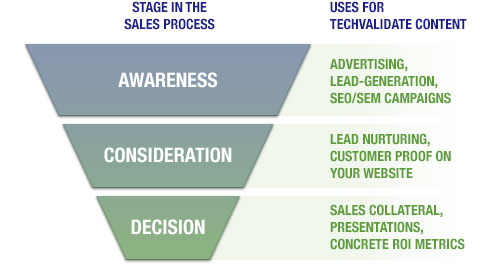
Now that you know how people make decisions, you can use this knowledge of the buying process to make a marketing funnel by creating content that will appeal to people at every stage. Take a look at the following sales funnel temp  to see how this translates:

funnel
As you can see, each color-coded piece of the funnel pictured above roughly corresponds to stages 2-4 in the buying process. The widest tier at the top of the funnel represents “awareness,” the point at which potential customers are beginning their information search. The second tier is “consideration,” roughly corresponding to the evaluation of alternatives described in the purchase process above. And finally, the third tier, “decision,” is self-explanatory.
As a note, stages one and five have been left out of this model. Though all companies should have a plan for addressing post-purchase follow-up, it’s up to you to determine whether or not it’s worth your company’s time to try to reach buyers in the first stage of the process. It can be difficult to convince people that they have a problem if they haven’t already felt it themselves, but if you’re selling a new type of product that meets a previously unrealized need, you might want to focus your energy on this area.
For each stage of the funnel, you’ll need to answer the following questions:
  • How will customers at this stage find me?
  • What kind of information do I need to provide to help them move from one stage to the next?
  • How will I know if they have moved from one stage to another?
The image above gives some hints as to how you might answer some of these questions, and you’ll find that some are easier to answer than others. To continue with our earlier example, let’s explore how Norman could answer each of these questions in order to create the foundation of his marketing funnel:

Stage 1 – Problem/Need Recognition

Because Norman sells a high-dollar software product that meets a need that most businesses are familiar with, he decides that it’s easier to focus on attracting and converting customers who already know that they need his product, rather than trying to create the need in the first place. If he was a startup or a company with a new idea, he might choose to invest more of his time and energy here.

Stage 2 – Information Search

How will customers at this stage find me?
Given the broad appeal of his product and its high-dollar nature, Norman decides that the following strategies will be most appropriate:
  • Paid advertising on Google AdWords that lead visitors to a landing page with an opt-in form requesting a free online demonstration
  • Guest blog posts on industry websites that provide viewers with unbiased information on what to look for when buying his type of software
  • Optimizing his website for keywords that indicate an information search in  progress in order to capture organic search traffic
  • Social media posts that educate viewers on a wide variety of industry issues
What kind of information do customers at this stage need?
  • Content that confirms that the need they’ve perceived is valid and should be remedied (for example, blog posts that appeal to the visitor’s frustrations with emotional descriptions of the problem and how the product solves it—“Why X is a Problem and What You Should Do About It”)
  • Content that describes the attributes of the product to encourage viewers to include in their future evaluation of alternatives (for example, blog posts with titles like “Getting to Know Product X”)
  • Content that introduces the company and intrigues the potential customer enough to move to the next stage of the buying process (for example, Facebook posts on “Behind the Scenes at Norman’s Company”)
How will I know if customers have moved on to the next stage?
Norman will know when customers have moved on to the “Evaluation of Alternatives” stage when they request a free online demonstration, indicating that they are interested enough in the product to compare it against others.

Stage 3 – Evaluation of Alternatives


How will customers at this stage find me?
Most prospects will enter this stage after identifying Norman’s company as a possible alternative and completing the information search process described in Stage 2. However, some customers might be introduced to his brand after completing Stage 2 with his competitors, as in the case of an industry blog running a comparison chart of the different competitors in his space.
As a result, Norman decides that it’s prudent to set up Google Alerts for his competitors’ names. Whenever they appear online, he makes it a point to try to get his company mentioned as well by reaching out to publishers, leaving comments, and responding to questions he sees about his competitors.
What kind of information do customers need at this stage?
  • What differentiates Norman’s product from his competitors’ products? Instead of relying on external sites, Norman could create his own product comparison chart showing how his product is different from others.
  • Have other buyers been successful with Norman’s product? Case studies of past customer successes can be extremely helpful in terms of moving customers from the evaluation stage to the purchase decision.
  • Why should they purchase from Norman? To meet this need, Norman might publish a white paper based on primary research he’s conducted that establishes himself as an industry authority (or, better yet, he might place this behind an opt-in form that causes visitors to take the psychologically-compelling step of engaging further with his brand).
How will I know if customers have moved on to the next stage?
Visitors who move on to the next stage are those that make a purchase, so any indication that the buying process has begun means success — from verbal confirmation of a deal’s acceptance to the receipt of a formal contract. However, if Norman uses an online shopping cart system, he might also find it useful to track abandonment rates, as reaching out to these customers could help reveal reasons visitors aren’t progressing to the next stage or provide salespeople with leads that can be easily closed with a single outreach phone call.

Stage 4 – Purchase Decision

How will customers at this stage find me?
Customers at this stage will have already found Norman’s company by progressing through stages 1-3.  There is no extra outreach Norman needs to do at this point, as it is exceedingly rare for customers to purchase without conducting any type of information search or comparison of alternatives.
What kind of information do customers at this stage need?
Since Norman is selling a high-dollar product, he needs to do two things: help prospects be comfortable with the purchasing process and make the purchase process as easy as possible.
  • To help make customers comfortable, he decides to create a few blog posts on what happens after the purchase is completed to ease potential worries about investing with his company (for example, “10 Ways Norman’s Company Simplifies Software Onboarding”).
  • To minimize confusion, he adds information to his checkout pages in order to make it as obvious as possible what prospects should do next in order to purchase his solution.
How will I know if customers have moved on to the next stage?
Customers will move on to Stage 5 when the sale is complete. Although we won’t detail it here, Norman should brainstorm the kinds of information these customers will need, as well as how he’ll provide it as part of a cohesive onboarding process. Though he doesn’t need to worry about customers finding him at this stage or moving on to the next one, it’s still important to meet their needs so that they walk away feeling good about their purchase decisions!
After completing this brainstorming process, Norman creates an overall list of all the different content pieces he’ll need to create and deploy, including:
  • Google AdWords ad copy
  • Landing pages with lead generation forms for customers requesting online demonstrations
  • Guest blog posts
  • On-site page and blog content written for SEO keywords
  • Blog post: Why X Is a Problem and What You Should Do About It
  • Blog post: Getting to Know Product X
  • Blog post: 10 Ways Norman’s Company Simplifies Software Onboarding
  • Social media posts: Behind the Scenes at Norman’s Company
  • Product comparison chart
  • Case studies from successful customers
  • White paper
  • New checkout page content
Since this is a significant amount of content, Norman can choose to roll it out over time, enlist other employees in the creation process or outsource some of it to freelance workers.

Another Way to Remember Content Creation Stages:

There’s another way to remember stages of the sales funnel and match it to content creation — with the acronym AIDA:
  • Attention: This is similar to the problem/need recognition stage. Customers experience a problem, but must recognize the problem. You create content to draw attention to the need.
  • Interest: Interest and information both start with the letter “I.” This is the stage at which customers are actively seeking, or interested in, information to help them solve their problem. As they move through the sales funnel from recognizing or drawing attention to the problem, their interest is sparked in a solution. They need information to move into the next phase.
  • Desire: Customers have moved from attention or recognition of the problem through information-gathering and interest. Now they have a desire for a solution. Customers evaluate alternatives and your job, through content creation, is to spark a desire for your solution. You must convince customers, as they examine various solutions to their problem, that your solution is the right one for them.
  • Action: Now it is time for customers to make the purchase decision, or to take action. Make it easy for them to say “yes” to taking action. Have a strong call to action in your copy, and a simple path to follow to complete the sale. The easier you make it for people to take action, the more sales you’ll generate through your sales funnel


Monday, 24 July 2017

Top 10 SEO Blogs to Follow in 2017

Top 10 SEO Blogs to Follow in 2017


1. The Moz Blog
Blog: http://moz.com/blog
Twitter: @moz
Founded in: 2004
2. Search Engine Journal
Blog: http://www.searchenginejournal.com
Twitter: @sejournal
Founded in: 2003
3. Search Engine Land
Blog: http://searchengineland.com
Twitter: @sengineland
Founded in: 2006 by Sullivan after he left Search Engine Watch
4. Search Engine Watch
Blog: http://searchenginewatch.com/
Twitter: @sewatch
Founded in: 2009
5. Semrush
Blog: https://www.semrush.com/blog/
Twitter: @semrush
Founded in: 2008
6. Matt Cutts
Blog: http://www.mattcutts.com/blog/
Twitter: @mattcutts
7. SEO BOOK
Blog: http://www.seobook.com/blog
Twitter: @seobook
Founded in: 2003
8. Bruce Clay
Blog: http://www.bruceclay.com/blog
Twitter: @BruceClayInc
Founded in: 2008
9. SEO Chat
Blog: http://www.seochat.com/
Twitter: @devseochat
Founded in: 2003
10. SEO Organic
Blog: https://www.seoorganic.co.uk/blog/
Twitter: @seoorganic_ltd
11. SEO  Tips & Tricks:

Monday, 17 July 2017

how to increase domain authority

What is Domain Authority?

There are countless websites, some are better than the others while some are still struggling. The question is that how do we get to know that which website is doing well, having a visibly solid reputation. Now you must be thinking that there must be some sort of criteria for judging that and you are certainly right. Domain Authority or DA is that statistical measure which is used to find out the reputation of a particular website which is provided by SEOmoz or better known as Moz. It is a statistical number from 0 – 100 which was developed by Moz in order to determine how does a domain rank in results of Google search engine. However, it is not the same thing as that of page authority. The difference between page authority and domain authority is rather significant as page authority is the ranking potential of a single web page whereas domain authority tells us about the overall ranking potential of the entire domain or subdomains.

Domain Authority vs. Page Authority

The first step towards finding out how to increase domain authority is to properly understand the difference between page authority and domain authority for which you will be needing a quality domain authority checker. Domain authority gives you the score for your whole domain while page authority will only give you the score for your web page. Unlike DA, page authority allows to figure out the predictive ranking strength of a single web page rather than the whole domain.

Trust Flow vs. Domain Authority

If you are on this page then you must be looking for a way to find out how strong is your website’s presence in search engine results. In search engine optimization or SEO the need often arises to know the strength or authority of a website. As you now know that DA is the statistical measure that can tell you about the authority of your website. However, there is another very important metric that can be useful to know how strong a website is. Trust Flow or TF from Majestic and DA from Moz are two different metrics that can serve this purpose.
Both these measures help SEO professional greatly to determine the strength or authority of a website. Now you must be thinking do they tell us about the same thing, aren’t you? Let’s find out. There has been a lot of hype about trust flow lately all over the SEO community, however there’s a difference a between trust flow and DA. Unlike DA which tells about the authority of a domain in search engine, trust flow is a number that helps predicting how trustworthy is a web page based on how trustworthy websites tend to link to the trustworthy neighbors.

How to Increase Domain Authority?

How to increase domain authority? It is a simple yet critical question than can alter the life of any webmaster. If you are a website owner than you must already have an idea about how important it is to have a good domain authority score. Let’s discuss a few ways which can help you to know how to increase domain authority: - On-site factors are the most significant when it comes to your websites ranking and DA. Then why not first work on on-page SEO and on-site optimizations while considering the user-experience. - High-quality and engaging content is indeed the backbone of any winning website. - Social media can’t be ignored as it is important for your brand awareness and the exposure of your website.

Saturday, 8 July 2017

how to Convert Leads into Sales

Digital marketing flow for convert Leads into Sales:

Trailing Stop Loss in angel one

PageNavi Results No. (ex: 7)

Find Us On Facebook

About Me

My photo
Technical Trainer for Full Stack Web Development & Digital Marketing Course
Powered by Blogger.

Flickr

Find Us On Facebook

Video Of Day

Video Of Day

Fixed Menu (yes/no)

Related Posts No. (ex: 9)

Follow us on FaceBook

Fixed Menu (yes/no)

Animation - Scroll IMG (yes/no)

About

Gallery

Gallery

statistics

Search This Blog

PageNavi Results No. (ex: 7)

Flickr

Follow us on FaceBook

About

Formulir Kontak

Name

Email *

Message *

Flickr

Follow us on FaceBook

Animation - Scroll IMG (yes/no)

About

Gallery

DIGITAL MARKETING TECHNIQUES


© 2013 Digital Marketing by Om Sir. All rights resevered. Designed by Templateism

Back To Top